

B-ADSc, Decision, Organisation, AI
B-ADSc, Decision, Organisation, AI
B-ADSc: the decision analysis that links organisation and automation
B-ADSc: the decision analysis that links organisation and automation
Published on
Why does a request stay stuck despite clear processes? B-ADSc analyses how each activity decides, and what it can delegate.
Why does a request stay stuck despite clear processes? B-ADSc analyses how each activity decides, and what it can delegate.
A small amount demonstrates neither low complexity nor low risk.
A small amount demonstrates neither low complexity nor low risk.
A small amount demonstrates neither low complexity nor low risk.
Philippe Gautier, Spentia.
An organisation can have a clear organisation chart, documented processes and complete dashboards, and still be unable to explain why a request stays stuck. Who was supposed to decide? With what information? Which gap should have triggered a response? Who could take back control?
The organisation chart places responsibilities and reporting lines (who should be responsible for what). The process map describes sequences (how things are supposed to be done). These representations are useful, but they do not necessarily show how, in reality, a person interprets a situation, arbitrates between competing demands and checks the consequences of their decisions. This is even more true when things get complicated and evolve in a direction nobody anticipated. That is precisely the subject of B-ADSc, the decision analysis of complex systems.
Its unit of analysis is therefore not only the task performed. It is the activity that steers resources to reach an objective. The actigram, a representation of the operational hierarchy of these activities, shows how objectives are delegated and how the information needed for steering travels back up. It does not necessarily reproduce the boxes of the organisation chart.
An engineering method, before it was a consulting method
Developed by Janusz Bucki, B-ADSc belongs to cybernetic thinking and systems theory. It studies control loops, interactions between levels and the purposes that make behaviour intelligible. Bucki and Yvon Pesqueux explicitly place its origin in the design of complex automation systems, before its transposition to management.
Its roots are in engineering: describing components, their decisions, their interfaces and their operating conditions. The manual covers real time, operating modes and dependability. This requirement matches that of critical industries: anticipating how a system reacts when nominal conditions no longer hold, rather than describing only its expected operation.
On 10 October 2002, Janusz Bucki published the reference article AG1570, “Analyse décisionnelle des systèmes complexes” (decision analysis of complex systems), in Techniques de l’Ingénieur. It already linked human organisation, automation and information systems.
Trained by Janusz Bucki, I now pass this method on to Spentia’s partners. The aim is to pass on a discipline: make decisions explicit before reorganising resources or choosing tools.
The activity: a purpose, a conduct and resources
An activity is defined by three inseparable elements: its purpose, the objectives it can meet; its conduct, the decisions and know-how it uses; its resources, what it can act on. It becomes a decision-making unit when a pilot carries out its conduct. This pilot can be human or technical. One person can pilot several activities: an activity and a job are not the same thing.
Each activity sits between an environment, which assigns it objectives, and a process, made up of the resources it steers. This organisation is recursive: a sub-activity in turn has its own environment and resources. This is called a holonic structure: each activity is a whole for its resources and a part of the system that contains it.
Four memories, four distinct roles
The notations M1 to M4 are a convention for representing the model’s categories of indicators. They designate information roles, not necessarily four separate databases.
M2, the memory of external objectives, or Oext, contains what is asked of the activity. An external objective expresses a result to obtain or a situation to maintain, with its constraints. “Using software” designates a means; what its use must make it possible to achieve still has to be established.
M4, the memory of the signalled evolution of the process, or Evp, contains the information received through the signalling interface: observed states, events, reports. It is not the whole of “reality”. The data have already been acquired, selected or formatted; their meaning for the activity has yet to be built.
M3, the memory of internal objectives, or Oint, holds what the activity expects from its process after a decision. It carries the target states, assumptions, horizons and criteria needed to assess the evolution obtained. Reducing it to a repository of general rules would break the link between decision and expected result.
M1, the memory of the internal state, or Eint, represents the situation as the activity understands it. This state is self-referential: it relates information to its own objectives and know-how. It is not a truth independent of the pilot’s point of view.
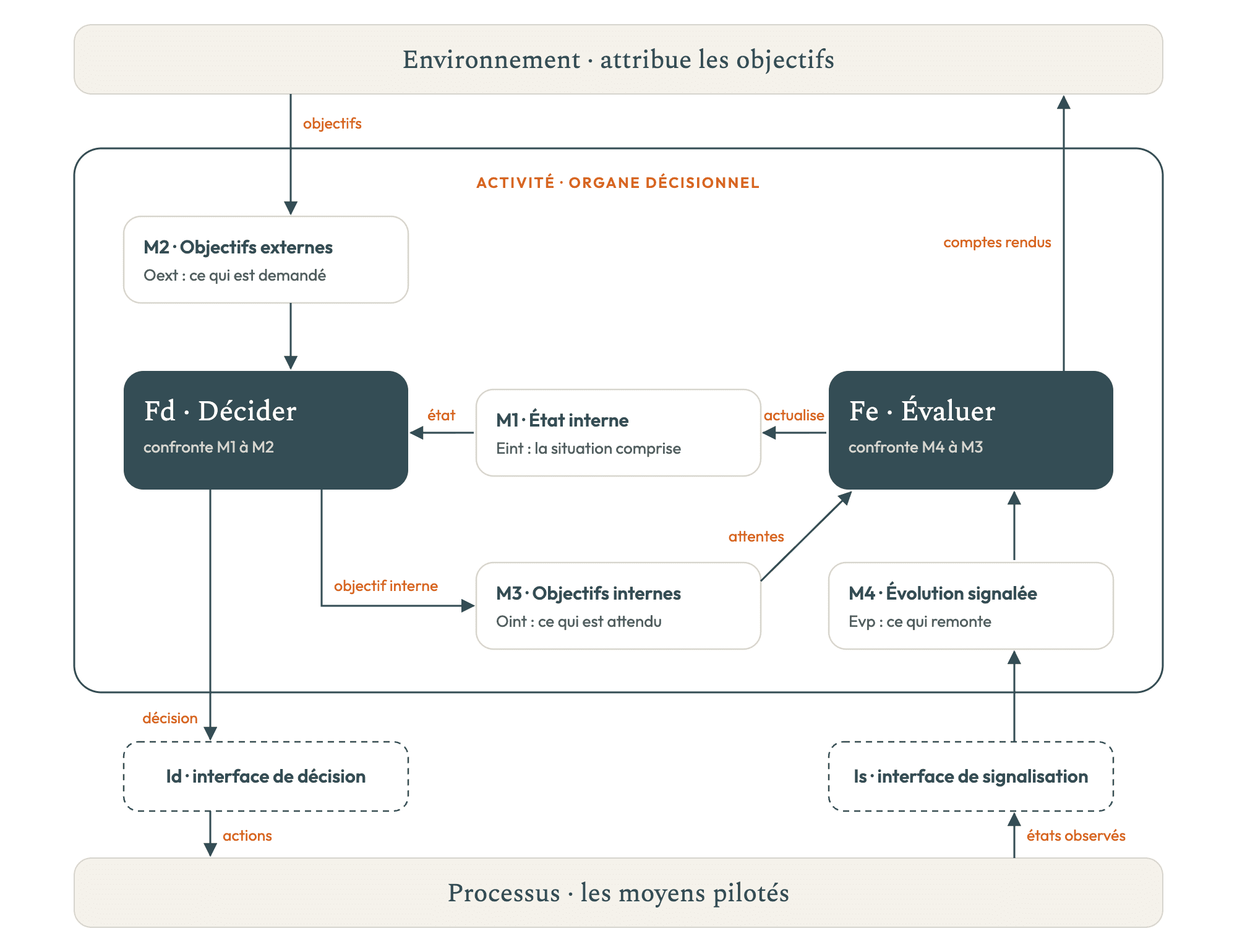
Diagram after Janusz Bucki, redrawn for Spentia. The relationships shown do not imply that Fe and Fd run simultaneously.
Evaluate, then decide
The evaluation function Fe compares M4 with the expectations in M3 and updates M1. It answers one question: what does the observed evolution mean compared with what I expected? The decision function Fd compares M1 with M2 and produces a decision, together with a new internal objective in M3. In simplified notation:
Fd(Oext, Eint) → decision and internal objective
Fe(Oint, Evp) → updated internal state and any reports
These functions alternate: the activity does not decide and evaluate at the same time. Several activities can, however, run asynchronously. Fe can update a state without issuing a report; the absence of a message is therefore not enough to prove the absence of evaluation.
The decision interface Id translates the decision into actions that the resources concerned can understand. The signalling interface Is turns their external states into information the activity can use. These interfaces belong to the information system that contains it. Carrying a piece of data, understanding its meaning and authorising an action are distinct operations.
Tolerance, sensitivity and prioritisation
Tolerance is the largest gap between external objective and internal state that is judged not significant. Sensitivity determines which evolutions of the process become significant with regard to the internal objective. These parameters have a prescribed dimension and an effective dimension, linked to the pilot. Inconsistency between levels can dampen a decision or make a difficulty invisible to the level that should handle it.
The planning function Fp selects the external objective to pursue among several objectives valid at the same time, according to the internal state and preference rules. It characterises second-category activities, notably shared resources. The self-creation function Fc, specific to the third category, makes it possible to create and take on new objectives. Inventing a new way to reach an existing objective, on the other hand, is a matter of learning.
This latitude makes goal convergence central: objectives pursued locally must contribute to the overall objectives. In B-ADSc, culture notably comes in as the internalisation of the rules for sharing useful and scarce resources. It therefore concerns the trade-offs actually made, not only the stated values.
An engineering method, before it was a consulting method
Developed by Janusz Bucki, B-ADSc belongs to cybernetic thinking and systems theory. It studies control loops, interactions between levels and the purposes that make behaviour intelligible. Bucki and Yvon Pesqueux explicitly place its origin in the design of complex automation systems, before its transposition to management.
Its roots are in engineering: describing components, their decisions, their interfaces and their operating conditions. The manual covers real time, operating modes and dependability. This requirement matches that of critical industries: anticipating how a system reacts when nominal conditions no longer hold, rather than describing only its expected operation.
On 10 October 2002, Janusz Bucki published the reference article AG1570, “Analyse décisionnelle des systèmes complexes” (decision analysis of complex systems), in Techniques de l’Ingénieur. It already linked human organisation, automation and information systems.
Trained by Janusz Bucki, I now pass this method on to Spentia’s partners. The aim is to pass on a discipline: make decisions explicit before reorganising resources or choosing tools.
The activity: a purpose, a conduct and resources
An activity is defined by three inseparable elements: its purpose, the objectives it can meet; its conduct, the decisions and know-how it uses; its resources, what it can act on. It becomes a decision-making unit when a pilot carries out its conduct. This pilot can be human or technical. One person can pilot several activities: an activity and a job are not the same thing.
Each activity sits between an environment, which assigns it objectives, and a process, made up of the resources it steers. This organisation is recursive: a sub-activity in turn has its own environment and resources. This is called a holonic structure: each activity is a whole for its resources and a part of the system that contains it.
Four memories, four distinct roles
The notations M1 to M4 are a convention for representing the model’s categories of indicators. They designate information roles, not necessarily four separate databases.
M2, the memory of external objectives, or Oext, contains what is asked of the activity. An external objective expresses a result to obtain or a situation to maintain, with its constraints. “Using software” designates a means; what its use must make it possible to achieve still has to be established.
M4, the memory of the signalled evolution of the process, or Evp, contains the information received through the signalling interface: observed states, events, reports. It is not the whole of “reality”. The data have already been acquired, selected or formatted; their meaning for the activity has yet to be built.
M3, the memory of internal objectives, or Oint, holds what the activity expects from its process after a decision. It carries the target states, assumptions, horizons and criteria needed to assess the evolution obtained. Reducing it to a repository of general rules would break the link between decision and expected result.
M1, the memory of the internal state, or Eint, represents the situation as the activity understands it. This state is self-referential: it relates information to its own objectives and know-how. It is not a truth independent of the pilot’s point of view.
Diagram after Janusz Bucki, redrawn for Spentia. The relationships shown do not imply that Fe and Fd run simultaneously.
Evaluate, then decide
The evaluation function Fe compares M4 with the expectations in M3 and updates M1. It answers one question: what does the observed evolution mean compared with what I expected? The decision function Fd compares M1 with M2 and produces a decision, together with a new internal objective in M3. In simplified notation:
Fd(Oext, Eint) → decision and internal objective
Fe(Oint, Evp) → updated internal state and any reports
These functions alternate: the activity does not decide and evaluate at the same time. Several activities can, however, run asynchronously. Fe can update a state without issuing a report; the absence of a message is therefore not enough to prove the absence of evaluation.
The decision interface Id translates the decision into actions that the resources concerned can understand. The signalling interface Is turns their external states into information the activity can use. These interfaces belong to the information system that contains it. Carrying a piece of data, understanding its meaning and authorising an action are distinct operations.
Tolerance, sensitivity and prioritisation
Tolerance is the largest gap between external objective and internal state that is judged not significant. Sensitivity determines which evolutions of the process become significant with regard to the internal objective. These parameters have a prescribed dimension and an effective dimension, linked to the pilot. Inconsistency between levels can dampen a decision or make a difficulty invisible to the level that should handle it.
The planning function Fp selects the external objective to pursue among several objectives valid at the same time, according to the internal state and preference rules. It characterises second-category activities, notably shared resources. The self-creation function Fc, specific to the third category, makes it possible to create and take on new objectives. Inventing a new way to reach an existing objective, on the other hand, is a matter of learning.
This latitude makes goal convergence central: objectives pursued locally must contribute to the overall objectives. In B-ADSc, culture notably comes in as the internalisation of the rules for sharing useful and scarce resources. It therefore concerns the trade-offs actually made, not only the stated values.

Before choosing automation, you must be able to describe this link and the conditions for controlling it.
Before choosing automation, you must be able to describe this link and the conditions for controlling it.
Point of view
Point of view
Before choosing automation, you must be able to describe this link and the conditions for controlling it.
Point of view
Failures: when apparent balance hides the problem
The manual distinguishes two regressive modes that must be read precisely.
In accommodation, the pilot increases their tolerance. The situation does not improve, but the gap stops being considered a problem. In falsification, the internal state becomes distorted: the pilot regains an apparent balance by building a perception that moves away from the situation of the process. This is a mechanism of the model, not an automatic accusation of individual deceit.
As an illustration, a team could end up considering a recurring delay as normal: accommodation. It could also produce a reassuring picture by setting aside the information that signals this delay: falsification. In both cases, the return to a perceived balance does not prove that the operational problem has been dealt with. Learning, for its part, consists of developing know-how. Revising a threshold can be legitimate; the point is to distinguish a deliberate adaptation from a problem that has only disappeared from the dashboard.
Other failures concern the structure: incompatible objectives with no arbitration; decisions that do not become effective actions; indicators that feed no useful evaluation; delegations whose scope and limits are not explicit. The analysis looks for the point of rupture between objective, understanding, decision, action and feedback.
One clarification avoids a misreading of matrix organisations. A first-category activity pursues only one external objective at a time and depends on a single parent unit, the higher activity that assigns its objectives. B-ADSc accepts several explicitly identified parents for second- or third-category activities. Having several sources of objectives is therefore not, in itself, an anomaly. You need to examine how they fit together and how competing objectives are handled.
Delegating and automating: the same organisational problem
In B-ADSc, delegating means entrusting an activity with conduct decisions, through the objectives it receives. Automation applies this logic when steering is carried out by a technical device. The organisational question comes before the technology choice: what are we delegating, and then which pilot can actually take it on?
Delegation requires an explicit objective, a decision domain, accessible resources, a horizon and information that makes it possible to evaluate the effects. Its implementation must also set out the conditions for interruption, escalation and taking back control. Reversibility concerns delegation and control; it does not mean that all the consequences of an action can be undone.
[Inference] For an AI project, this reading shifts the scoping. The first question is no longer “which task can we automate?” but “what decision-making power will we delegate, within which limits and with what feedback?”. Preparing a proposal, validating its content and sending it involve different responsibilities. Merging them into a single automated step leaves part of the delegation implicit.
[Inference] A generated text is therefore neither an authorisation to act nor proof that the objective has been reached. The device must remain attached to an identifiable activity, whose decisions and results can be examined. The steering architecture is not limited to the choice of AI model.
How Spentia moves from listening to an action plan
At Spentia, Aria conducts the interviews with employees in the chosen scope. It collects difficulties, dependencies and workarounds, but also the practices that work and the opportunities for improvement. The coverage goal is the whole scope; actual participation must be documented.
The partners take this material to rebuild the activities and decision chains. They examine what is asked, understood, decided and reported. Differences between accounts must not be erased to obtain a uniform map: they can signal different objectives, distinct interpretations or incomplete knowledge.
Bucki’s approach combines modelling, recursive decomposition and bottom-up reliability building. The actigram is tested against possible disruptions; the feasibility study then examines skills, resources and the choice of pilots. The organisation chart expresses this operational assignment. Finally, managing adaptation re-examines delegation, efficiency and autonomy: the model is not a fixed target.
The action plan and the automation plan come from this same analysis. A delegation to clarify, an arbitration to move or a piece of information to make usable can come before tooling. Each workstream must specify the change it seeks and how its effects will be checked.
The €2,800 quote behind the €80,000 one
The Spentia website uses this motif: “a €2,800 quote waits behind an €80,000 quote”. We keep only this contrast, without taking up the context of the published case. These amounts do not define delegation thresholds.
[Inference] The reading below is a methodological illustration, not a reconstruction of an engagement.
Consider an activity responsible for producing a compliant proposal within the agreed time. Its external objective, M2, would carry this requirement. M4 would receive the information needed to review the files and the feedback from costing. M3 would set out the expected results and their verification criteria. M1 would express the situation as understood: incomplete file, check required, proposal ready for validation.
The investigation would need to decide between several explanations. Is validation capacity saturated? Are files waiting for information? Do the delegations forbid a local validation that would otherwise be possible? Is there a preference rule for the shared resource? The blockage can come from how resources are shared, from delegation or from how the state of the files is perceived.
Above all, a small amount demonstrates neither low complexity nor low risk. Systematically giving priority to small quotes would be a premature conclusion.
An organisation to test could separate the files whose validation conditions are established from those that need further assessment. Fp would select the active objective when several files call on the shared resource. Fd would determine the appropriate conduct; Id would translate it into actions and delegated objectives. The feedback received would then allow Fe to update the situation.
The effectiveness of this change would still need to be checked on lead times by category, rework, errors and the validator’s workload. The value of B-ADSc here is to turn a complaint about slowness into verifiable questions about how decisions are organised, without presuming the answer.
The limits: a model is not proof of reality
B-ADSc does not choose the purposes of a company in place of its leader. It replaces neither business expertise, nor operational research, nor economic analysis. Activity-based costing, in particular, offers a separate view of costs and their causes.
An interview shows that a person described a situation; it does not automatically demonstrate its frequency, cause or cost. The model must distinguish statements, observations, hypotheses and contradictions. Important conclusions call for cross-checking against documents, available records and the people concerned. Missing data remains an unknown.
Finally, formal does not mean infallible. Defining the functions and checking the consistency of a model does not prove that the real organisation follows this model, nor that its future results are secured. The level of detail chosen must serve a steering question, without turning the diagnosis into an endless inventory.
B-ADSc thus links two questions that are too easily separated: how does the organisation decide, and which decisions can it delegate? Before choosing automation, you must be able to describe this link and the conditions for controlling it.
Sources
[1] Janusz Bucki, “Analyse décisionnelle des systèmes complexes” (decision analysis of complex systems), Techniques de l’Ingénieur, AG1570, 10 October 2002. DOI: 10.51257/a-v1-ag1570.
[2] Janusz Bucki, B-ADSc, ingénierie des systèmes et des organisations (B-ADSc, systems and organisation engineering), manual, November 2007, pp. 17 to 19, 47 to 72, 180 to 191.
[3] Janusz Bucki and Yvon Pesqueux, Organe décisionnel et contrôle : délégation et automatisation (decision-making unit and control: delegation and automation), HEC working paper. HAL repository: hal-00494172.
[4] Janusz Bucki and Yvon Pesqueux, Culture, maîtrise, liberté, convergence des buts (culture, control, freedom, goal convergence). HAL repository: hal-00509586.
[5] Spentia, example of an operational action plan, illustrative quote motif.
[6] Michel Lebas, Comptabilité analytique basée sur les activités, analyse et gestion des activités (activity-based costing, activity analysis and management), Revue française de comptabilité, no. 226, September 1991.